Sunday, February 1, 2015

On Life and Death

Yesterday we celebrated a life and a birthday. Lola was born four years ago - January 31, 2011 - and she came to live with us a short while later, a tiny little Chihuahua that fit in your hand. She amazes us all the time with her intelligence, and makes us laugh because she is so "tough" and yet so "wimpy." She is locked in to everything her "daddy" says, and always ready and eager to "go for a ride," she is a constant joy in our lives. We are blessed to know her.
Yesterday we also celebrated a life while we mourned the loss of Toby, "the bestest dog in the whole world," who graced us with his presence for almost 17 years. Always a constant companion for two young girls, Toby learned many of the very "non-doggish" things they wanted him to do. He could give a "high-five" using either hand; he could "sit" when he wanted to; he would roll onto his back and "exercise" by kicking his back legs when told. He was the caretaker for all of our other dogs over the years, outliving them all. And until his degenerating hips made it impossible for him to climb on the top of the storm cellar, he spent much of his alone time up there, overseeing the farm as its guard and protector.
He had a good and long life, and he was a constant joy in our lives...we were blessed to have known him.
Yesterday, I also celebrated the life of an anonymous little song bird, and mourned it's death.
I tend to anthropomorphize things I observe in nature, despite my understanding of, and agreement with, Darwinian principles. I know that had our Toby been born a wild animal, he would have died long ago. Nature doesn't tolerate the predator with hearing loss and arthritic hips. Nature doesn't have a conscience. The words "life" and "death" are the words that we humans use to describe the states of "being" and "not being" for a wild animal.
I realize that animals are capable of understanding of death, and many even mourn the loss of one of their own. But for the predator, there is no place for mercy...no tolerance for pity.
There was no guilt in the Merlin yesterday when it knocked the song bird from the air. There was no sorrow in the hearts of the songbirds who escaped. And as shocked as I was to see that interaction play out right before my eyes, I know that I shouldn't feel sad for the song bird either. Guilt and sorrow imply that what happened was wrong in some way. It wasn't. It was simply survival of the fittest playing out right before my eyes.
So to the Merlin, master of the swift aerial attack, I salute your speed and agility, your keen eyesight, and incredible ability to react and close in for the kill. And to the little song bird, I celebrate your life, and nature was blessed to have you in it.
It's a funny thing, this living and dying.

Monday, September 16, 2013

Remembering some old friends...

(This was originally posted on StarParty on 22 January, 2013.  But as summer gives way to fall, and the old friends are coming around again, I thought it might be fun to add it here as well.  cdf)

I don't remember my exact words when Richard brought home his first telescope, about 20 years ago.  But I imagine my response was either, "What is that?" or "Where did you get that?"  It was, he told me as he placed the red tube on the table, a telescope, and he had picked it up in a trade with a buddy of his.  He was quite happy with the trade too -- he had exchanged an old car stereo for the telescope and a Dalmatian dog (the dog, it turns out, wasn't really part of the trade, but was just hitching a ride to what would become his new home).

I am pretty sure when he showed me that telescope, that Richard got "The Look."  Although I didn't know it at the time, Richard had always wanted a telescope.  And now he had one.  It was a Newtonian design, a cardboard tube with a built-in eyepiece and an aperture of about 4 and a half inches.  Maybe he took it out that night for a look at the moon.  Maybe he even took it out more than once.  I can't really recall, since I didn't see the attraction of it myself.  But if he did take it out, it wasn't more than a few times.  Richard was young, always busy with one thing or another, and the red telescope eventually ended up in "the junk room" with other unwanted and unused objects.

It was a few years later, when cleaning out that room that I came across that telescope again.  "We'll just see how well this thing works," I thought, and I took it outside.  Now bear in mind that I knew absolutely nothing about telescopes, so I can honestly say the poor little red tube never stood a chance.  What do you think you can see through a 4.5" cardboard Newtonian telescope in the daylight, holding it in your hands?  I can tell you what...NOTHING!  The instrument got only that one trial, and with its failure, I concluded that it was just a piece of junk.  Into the trash it went.

I forgot about the red telescope, but apparently Richard never did.  Last year, we were watching some TV show about space, and he said, "I used to have a telescope.  Whatever happened to it?  I've always wanted one, even when I was a kid."  And I had to try to defend myself and tell him how that red telescope wasn't any good anyway -- that I knew it wasn't because I had tested it out one day -- and finally confess that I had thrown it away years ago.  I could tell he was disappointed, but he never mentioned it again.  But it was Christmas, and with that, I had my chance for redemption.  I suggested that maybe he might like to get a telescope, and we decided that he would shop around to see what kind he might want to get.  A week or so later, he placed his order for an Orion XT10i.

It was a long one-week wait, and when the scope finally arrived, Richard wasted no time in laying out all the pieces and getting started on the assembly.  Compared to the little red tube, the slick and shiny Orion telescope was a monster!  It was like replacing your '78 Pinto with a shiny new Corvette!  We named the telescope "Newton" -- an original name, right?  (It's consistent with our naming the Oscar fish "Oscar.")  Richard couldn't wait to get it out for a test drive!  He took it outside, sighted in the finder on a road sign and then waited impatiently for nightfall.

The Great Orion Nebula As newbies, I will readily admit that we knew almost nothing about the night sky.  We did know a few of the constellations -- shapes and names that we had learned as kids -- but that was about it.  We didn't even know the names of any stars to use to align the Intelliscope controller.  So we started out just pointing the telescope toward something and trying to find that something in the finder. I think we looked at the moon a bit.  Richard had seen some pictures of M42 on a website and suggested we try to find it.  He pointed the telescope toward the constellation Orion and scanned the area with the finder.  He stopped moving the scope.  When he looked through the 25mm Plossl eyepiece, I heard him utter what has become a very familiar phrase.  "Wow..."

And he was right.  The sight was nothing short of breath-taking.  Over the first few weeks, Richard took Newton out many more nights, but every session included (and usually concluded) with another look at M42.  But slowly we learned the names of different stars (although I wouldn't put money on our pronunciation!) and we learned about other targets in the winter sky.  Galaxies M81 and M82 were found just over the treetop one night.  The great Andromeda Galaxy, M31, was already so low in the sky early in the evening that it was difficult to see, but we searched for it and found it. Galaxy M51 is not a good winter target, but we searched for it in the glare of the streetlight below the hill. When we finally found it, we were the victors!  The dim "car headlights in the fog" galaxy couldn't hide from us!

Winter gave way to spring, spring to summer, summer to fall and with each season, Richard and I learned new names, and saw new and wonderful things in the night sky.  Now winter is here again, and when I walk out into the cold dark night and look up at the stars shining so brightly overhead, I can't help but feel a special fondness for what I see there.  The stars and constellations have become like old friends, passing overhead, each in its own season.  Orion the hunter, Taurus the bull, the Pleiades (known to me in my childhood only as the seven sisters), the brilliant star Sirius, Cassiopeia, the Big Dipper...I feel like I know them, and therefore they must know me.  Looking up into the night sky -- looking and understanding -- I think one can't help but be astounded by the immensity of it all, and appreciate just how profoundly unique, and incredibly special is our place in the universe.

Little red telescope, your legacy lives on.


Friday, July 12, 2013

A Temporary Refuge

The sun peeked through the trees at the edge of the thicket, melting the night's light frost everywhere it touched.  It found the cat sleeping in the thicket, and it's warmth caused her to stir.  She stood up and stretched, the long, lazy stretch of a cat who really didn't think waking up was that great of an idea.

But she had to get up.  Her situation was getting very desperate.  If she didn't find food - and find some very soon - she wasn't going to live to see many more late winter mornings.

She wasn't quite sure how she had gotten into this predicament.  After all, she was Himalayan, with a long creamy white coat, chocolate fur on her face, ears, and feet.  Her eyes were a piercing blue color.  She had been beautiful once upon a time, and she had been loved.

But then something happened that she didn't understand.  First her old woman had gone away, and now her old man no longer opened the door to let her in.  There were strangers who occasionally came to her house. She didn't know them, and she didn't trust them.  So she had taken refuge in the thicket.

But doing without the comforts provided by the old woman and the old man had taken a heavy toll on her. Her flea collar had long since stopped working, and her pretty pink collar, studded with rhinestone-shaped kitty footprints when new, was dirty and missing several jewels.  It chafed her neck where her long hair had gotten tangled around it.  Her once beautiful coat was matted and pulling loose from her skin in places.  Worst of all, she was starving.

She had roamed the thicket for a while now.  She had wandered as far as the paved road, sometimes sitting on the shoulder watching the comings and goings of the people who lived in her neighborhood.

She had passed by one house where she knew she might find some food.  She had considered going to that house, but there were risks in showing herself there.  The house had other cats, but it also had three large dogs.  Several times she made her way from the thicket across the field to the edge of the yard.  She sat and watched the routine of the house, and watched where the dogs were likely to be, and listened for the woman at the house to put out food for the cats.

But it was clear to her now that going to that house was her best, and perhaps only option.  She had to eat.  She left the shelter of the thicket, and made her way through the field to the edge of the yard where she hid in the tall grass, waiting for the woman to put out food for her cats.

It was late that evening when the woman finally came out.  Her desperation overcame her fear, and she dashed across the yard and launched herself right into the middle of the food bowls.  She was frantic as she grabbed the food.  "What's this?" the woman exclaimed.  "What are you doing here?"  But the woman didn't scold her, and didn't try to chase her away.  Instead, the woman put another small scoop of food out for her, then stood back to watch.  "You're starving to death, aren't you," the woman said with a troubled frown.

She finished the food, but tonight she didn't go back to the thicket.  She found a safe hiding place on the woman's carport and settled down for the night.

Over the next few days, the woman put out food for her, away from the other cats and safe from the dogs.  The woman talked to her, and tried to pet her, but she was careful not to let the woman get too close.  After all, she didn't know her, and she didn't trust her.

The weather was becoming more unsettled as winter gave way to spring, and  one afternoon heavy clouds moved in.  Certainly it was going to rain.  She had endured the rain many times, and her hiding spot on the carport would surely keep her dry.  But the woman came to the door and called, "Here kitty, kitty, kitty...." The door was open.  The house was warmer, and it was dry.  She slipped through the doorway into the woman's house.

Thankfully, the woman didn't try to pet her again.  Instead, the woman rattled a small dish of food and led her into another room.  The woman knew what cats needed.  There was a water bowl, and a clean litter box, and a large couch with a soft crocheted afghan over it.  The woman sat down the bowl of food.  She heard the woman say "I'll call you Sassy," as she left the room.

Was Sassy her name?  It really didn't matter.  The woman took care of her, even if she was rather annoying. The woman took off the used-up flea collar (it was good to be rid of it).  But then the woman stole the pink collar too.  The woman didn't like the matted up hair, and would often interrupt a nice nap with the snip, snip, snip of scissors cutting the mats loose.  When she had endured all of this that she could stand, she would hiss at the woman.  Usually it worked.  The woman would leave for a little while and let her sleep.

The days passed.  One week went by, then another.  It was a cold night, and she had gotten to know the woman.  She had begun to trust her.  As the woman settled down in bed, she lightly jumped up onto the woman's shoulder and lay there, watching as the woman fell asleep.

It was a Saturday morning, one of the warmest days of the young spring.  She wasn't starving anymore, and she felt more like her old self than she had in a long, long time.  She went to the door and called to the woman.  "Do you want to go out?" the woman asked her.  Such a question...not worthy of an answer.  But the woman seemed to understand, and opened the door.  She stepped outside and heard the woman close the door behind her.

She made her way through the field, and late that evening, when the woman began to worry and to wonder where she had gone, she got up from her nap, stretched the long, lazy stretch of a cat who really didn't think waking up was that great of an idea.  She wasn't concerned that the woman was watching from the kitchen window of the house.  As twilight set in, she carefully groomed the beautiful chocolate fur around her face.  Then with a final stretch, she walked to the edge of the field and disappeared into the thicket.  She did not look back.
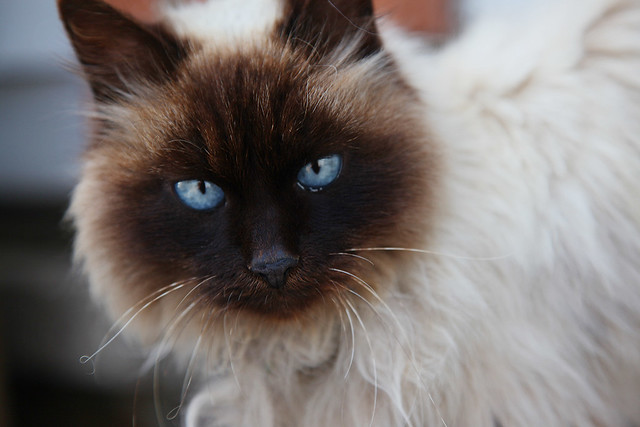

Sassy

Update  9/28/2013 - The woman finally saw the cat she called Sassy again in July.  The cat looked healthy enough, and she showed herself several more times during the last days of the summer.  But on September 28, the woman saw Sassy for the last time.  The cat's body lay in the grass on the side of the road.  The woman did not know what had happened...perhaps the cat had been hit by a car, or perhaps the large dogs in the neighborhood had finally caught her.  The woman gave Sassy a final refuge, burying her under the old oak tree.


An Unfortunate Case of Mistaken Identity

It was almost noon, and I was breaking up some ramen noodles  for lunch when the first text message came in.

"Dad wants to know what kind of snake this is," the message said.  "Hang on...I'm sending you a picture."

An email message popped up in my inbox with a link to the picture.  I opened it and there was a  gray sinister-looking snake, coiled up against the side of the house, head flattened out.   I looked closely at the picture and felt a little knot in my stomach.  It looked like a water moccasin, or cottonmouth as they're also called.

Ramen forgotten, I turned back to the computer and opened The Google.  "Cottonmouth snake," I typed in.  As the search results loaded, another text message came in.  This one was much more urgent:  "It was lunging at us and chasing us! And now it's on the porch and we can't find it!"

Of the cottonmouth, the Google said:
Agkistrodon piscivorus is a venomous snake, a species of pit viper, found in the southeastern United States. Adults are large and capable of delivering a painful and potentially fatal bite. When antagonized, they will stand their ground by coiling their bodies and displaying their fangs. Although their aggression has been exaggerated, on rare occasions territorial males will approach intruders in an aggressive manner.

Why on earth would a water moccasin be at our house?  The nearest body of water was the stock pond, about 1/8 of a mile or so down the hill.  But the why wasn't really important at the moment.  What mattered was finding the snake before it got under the house!  I grabbed my keys, left a message for my boss, and headed out the door.

All the way home, I was filled with dread, thinking about all the different ways the snake could get into the house (if you read my previous posts, you might remember that it's a very old house, with lots of cracks and gaps where critters can find their way in).  I thought about all the hiding places - the flower beds, the garden, the woodpile....  How would we ever feel safe again if we didn't find it?

But as I pulled in the driveway, the family motioned for me to stop.  They had it cornered up against the house, and didn't want to risk me scaring it off.  RAF was standing guard with the garden hoe, and we talked for a while, trying to get a better look, and trying to decide what to do.


Eventually we decided the best course of action was to shoot the snake, so we borrowed a 12-gauge shotgun and RAF killed it with one shot.

I put the snake into a bucket and took it to my mom's and dad's house.  My mom looked into the bucket at the snake and asked, "Did it smell bad?"  No, but it was sure aggressive I told her.

The next day I sent the picture to Dr. Knight, who teaches Biology at the local university.  It could be a cottonmouth, he said, but it looked more like a blotched water snake.  "But you still have to be careful around them," he added.  "They are very 'bitey.'"  How could I know for sure?  Look at the snake's eyes, he advised.  A cottonmouth has vertical pupils, like a cat, with deep pits and a very strong triangular shaped head.  The water snake's eyes would be round.

When I got home, I took a stick and carefully lifted the snake out of the bucket.  The pupils that stared out of his lifeless eyes were perfectly round.

"I didn't think it was a water moccasin," my mom told me later, "but I figured you two knew more about it than I did."  As it turned out, we didn't know anything about cottonmouth snakes after all.

Poor little blotched water snake.  Our fear and our ineptitude at snake identification brought a tragic end to his foray into our yard.  His coloration and behavior may have evolved they way they did because mimicking a cottonmouth gave him an advantage against his natural predators.  But, as Dr. Knight pointed out, the coloration that offers protection against natural predators becomes a risky way to dress when you bump into a frightened human.

Thursday, March 21, 2013

A Splash of Color on a Dreary Day

It's late March, and while the morning started out with broken clouds and moderate temperatures, by mid-day the sky had gotten darker, the temperature colder, and it wasn't long before a heavy drizzling rain began to fall.  A stiff breeze blew from the east, and all in all, it was just what I would call "thoroughly miserable" outside.

Don't misunderstand me...I am absolutely thankful for the rain.  After last summer's drought, I will forever feel blessed to have days like today.  But it's the kind of day that makes you just want to curl up under a warm blanket with a good book, or snuggle down and take a nice nap.  I had taken the day off work, since school is out for spring break, but I couldn't really find anything that I wanted to do, so I spent most of the day doing nothing at all.  Every now and then I wandered into the kitchen and leaned on the counter, peering out at the gray skies and the rain.

I like looking out in our back yard, because, for whatever reason, it always seems to attract a variety of birds.  Among the birds I've seen in our yard are cardinals, blue jays, blue birds, nuthatches, titmice, crows, finches, sparrows, starlings, mockingbirds, chickadees, quail, mourning doves, thrushes, meadowlarks, and juncos.  I was amazed by the number of birds (and the red squirrel) that were out and about, even on a day like today!

But today, we had a special guest, sporting an interesting and unusual cap, splashed with red.  Our guest was a Pileated Woodpecker (Dryocopus pileatus).


According to the Cornell Lab of Ornithology, the Pileated Woodpecker is one of the biggest, and most striking forest birds in North America.  I am just guessing, but I would say that this one was anywhere from 10" to 12" from the top of the red crest to the tip of the tail.  It was busy ripping bark off the stump of a dead pecan when I first saw it;  some of the bark pieces were tossed as far as 10' out into the yard!  As I watched, the bird worked its way down the row of trees, moving first to the mulberry tree, then on to this old red bud.  It worked its way around the trunk, tearing off bark, moving up and down the gnarled old tree before finally moving on to the next tree in the row.

Those old trees that seemed so attractive to the woodpecker may very well be one reason that the birds like our yard so much.  Most of the trees are at least 50 years old, and based on its diameter and a growth rate of about 1/8" per year, we estimate that the big oak in the front yard sprouted at around the time of the revolutionary war.

But I have plans to remove some of the older trees in our yard this spring, because they've become such a threat to the house.  One of the trees destined for removal is an old catalpa, which I've been told was planted in 1880 when the house was built.  Most of the tree has died, and I'm pretty sure the central portion of the tree is hollow.  I hope that the tree hasn't become the new home for this beautiful bird!  (Or for the red squirrel for that matter!)  What a tragedy that would be!  Now that I've seen this bird in the yard, I'll have to keep an eye out for it.  If it has moved into the catalpa, the tree man may have to come back another day.


Update:  3/22/2013 4:50 p.m. The Pileated Woodpecker was back this afternoon, and really did a number on the base of the old pecan stump!

There were three other woodpeckers out in the yard this afternoon...one downy woodpecker, and two Northern Flickers (Yellow shaft subspecies).  Flickers are very attractive birds, dressed in their humble brown feathers, decorated with black spots, a large black bib, and a splash of red across the nape of the neck.


In researching the identification for these birds yesterday, I came across the great site by The Cornell Lab of Ornithology, and decided to submit my bird sightings to eBird.org, a joint effort by the lab and Audubon.  I have officially submitted two checklists now, one for yesterday's sighting of the woodpecker, and a list with 9 species observed this afternoon.  Pretty cool, if I do say so myself!

Sunday, June 24, 2012

Invasion! Part 3 - June 19, 2012

(Continued from Part 2)

As day three of the striped blister beetle invasion began, I left for work with a new plan of action. We had achieved a small victory the night before, when I had found an old bag of Bug-B-Gone dust. Even though it was at least five years old, the dust had effectively put an end to the attack on our pepper plants.  So the plan was to buy another small bag of the dust (the active ingredient was permethrin) and treat the rest of the garden.

But even though I had decided on this course of action, it nagged at me throughout the day.  In general, I don't like pesticides, and try to avoid them if possible.  So what if there are a few worms in the corn?  I can spare a few kernels, right?.  Tomato worms?  Just keep an eye out for the signs of them, then pick them off and feed them to the pet oscar.  Squash bugs?  Spray some water on the base of the plants and pick them off as they crawl up the stems (squash bugs really can't swim, and seem to hate water!).

So the decision to use the permethrin on the garden triggered a case of guilty conscience. I remember swarms of June bugs (Cotinis nitida for those who are curious) on the corn tassels every summer when I was a kid.  This year I haven't seen a single one.  Nor have I seen more than a dozen honeybees this summer, although like the June bungs, the bees were always busy gathering working the corn tassels.  Where are the dozens and dozens of lightening bugs, which always punctuated the evening twilight with their flashing messages?  I found myself thinking "Do I really understand the broader impacts of using that pesticide?"  I was pretty sure the answer to that was "no."

Nevertheless, I found myself asking what choice do I have? On the way home that evening, I stopped at the Feed and Supply store and picked up a bag of "Garden, Pet, and Livestock Dust."  I took a plastic peanut butter jar out of the recycling and we drilled some holes in the lid.  I filled the jar with the white powder and walked around to the okra.  I started to gently sprinkle the dust on the leaves, covering the beetles.  Just as before, the beetles ran for the safety of the corn.   Only this time, I stood ready with the poison, and I spread it around the bases of the plants where they had taken refuge.  I then spread a 4" wide strip of the dust down the row between the corn and the beans, then lifted up the bean plants and sprinkled the dust on the ground and on the base of the bean plants.  The beetles ran for the corn, but had to cross the treacherous white line I had drawn in the dirt.  I emptied the jar, and left the dust to do its dirty work.

The carnage.

The next evening, I walked through my battered garden.  It seemed eerily quiet, but maybe that was just my conscience blocking out the sounds of everything around me.  The signs of the war were everywhere.  Dead and dying blister beetles lay in great piles.  The poison had done its job.  But here lay a dead tiger beetle, a beneficial and gorgeous predator Tetracha sp. (possibly Tetracha virginica).  Another dead predator, a spider, over there.  Numerous black Carabid beetles, also predators, also lay among the dead blister beetles.  


Sadly, I turned to leave the garden.  As I looked down, I saw a single solitary blister beetle walking across the ground at my feet.  I bent down and took a photo of the pest.  Then I stood up, raised my foot, and stomped on him.

Thursday, June 21, 2012

Invasion! Part 2 - June 18, 2012

(Continued from Part 1)


Okra leaf, showing the damage caused by striped blister beetles in just a few hours. This leaf was about 10 inches across.
When daylight came on Day 2 of the striped blister beetle invasion of our garden, I walked outside to survey the damage.

Surprisingly, it wasn't as bad as I had feared.  The only plants that showed any significant damage were the okra plants, and the worst of that was at the far end of the row, where I had not gone with my bucket and stick.  So I was somewhat hopeful as I left for work.  Perhaps the worst was over, and the situation was now under control.

However, around noon, I got an urgent message from home.  The invaders were back, and this time they weren't confined to the okra row.  Two of the Rutgers tomatoes were already being stripped.  They were munching the foliage on the potatoes and the corn.  They were starting to congregate on the pepper plants. "If we don't do something quick, we're not going to have a garden!" the message said.

How were we going to stop them?  Of course - ask The Google!  So I did.  The Google had heard of the striped blister beetles before, and had lots of suggestions about how to control them.  The year before we had used a spray, but I've tried very hard to avoid dusts and sprays.  The most promising solution seemed to be diatomaceous earth.  DE, as it is called, is really not "earth."  It is the fossilized remains of trillions of tiny creatures called diatoms.  The theory behind using it for insect control is that the sharp edges of the silica particles puncture the exoskeleton of the insects who come in contact with it.  This, in turn, causes the insect to become dehydrated and to eventually die.

While DE is a non-selective method of control (any insect that comes in contact with it could be killed), it doesn't last in the environment like some of the garden pesticides.  I decided it was worth a try, and made a last-minute stop at Blossomberry Nursery on my way home to purchase a bag of it.  Luckily, the nursery had one small bag left.

When I got home I went on the offensive.  I sprinkled the DE on top of the beetles hanging from the pepper plants and watched to see how they reacted.  Would they clutch their front legs to their abdomen and cry out "This is the big one!  You hear that, Elizabeth?  I'm coming to join ya, honey!"

If that was my expectation, I was to be sorely disappointed.  The DE seemed to have no effect on the beetles, other than causing them to run for cover.  I could almost see them looking up at me, laughing, and saying to each other, "Look!  It's snowing!  Wheeeeeee!" as they ran down the stems and over into the green beans.  Well, perhaps it just takes a while for them to succumb to the dehydration.  I walked around the entire garden and spread the stuff on and around as many plants as I could.  I emptied the entire 4 lb bag, and lamented that the nursery hadn't had a bigger one.  Then I went inside to leave the DE to its dirty work.

The sun set, and it was soon pitch dark out.  I took the flashlight out to look at the carnage - I wanted to see their hateful destructive little bodies littering the ground where the DE had sucked the life out of them.  Click. I shined the light on the ground.  Where were the carcasses?  I shined the light up on the pepper plants.  NO!!!!  It couldn't be true!  The beetles were back, and the leaves were no longer smooth and oblong.  They looked more like the leaves on a pin oak, with deep lobes all around them.  The beetles didn't appear to be the least bit ill.

I think it was at that moment that I had my epiphany.  While DE may be an effective method of insect control, it simply isn't the answer to an acute attack like the blister beetles were carrying out on our garden.  "It is like putting a band aid on a severed artery," I thought.  "Yes, you might stop bleeding, but it might be because you ran out of blood."  A control method that takes five days to work, I thought, is also going to give the invaders five days to eat.   By that time, everything in the garden would be decimated.

Sadly, I went back inside and picked up the ShopVac to once again fight the beetles who had found their way into the house.  As I vacuumed over the washing machine, I saw, sitting at the very end of the shelf, an old, old bag of Bug-B-Gone dust.  I turned off the vacuum and reached up to get the bag.  It was almost empty, and the seal had come unsealed.  There was no telling how long it had set there open.  But I supposed it was worth a try anyway.  If it didn't work, well, we were no worse off than we were right now.  If it did, the peppers might be saved.

Back at the garden, I shined the flashlight on the first pepper plant.  I took at scoop of the dust and scattered it over the beetles.  This wasn't like the other snow.  This wasn't fun.  The beetles were angry.  They began to swarm frantically around on the plant and began dropping off onto the ground.  I worked my way down the row, sprinkling the poison snow onto and around each plant.  That was all the bag had - just enough to treat the peppers.

What a wonderful sight I saw when I shined the light on that first plant.  The beetles were staggering around the base of the plant.  They were not well, not well at all.  I watched for a while, as their legs gave out and they fell onto their sides, legs twitching convulsively.

It had worked.